
- Joined
- 27 August 2018
- Messages
- 71,387
- Reactions Received
- 151,400
- Cards
- View Profile
- KS Coins
- 129,595
- Fandom
- Lex stan
- Gender
- Female
- Pronouns
- she/her
- Ship
- Wreck

![Super M [Ahsoka]](https://kpopsource.com/data/medal/1218_1600222072m.jpg)
![Rose Competition [Vikki]](https://kpopsource.com/data/medal/581_1610996728m.jpg)
![SHINee [Ahsoka]](https://kpopsource.com/data/medal/2238_1710820634m.jpg)
![STAR WARS EVENT [VIKKI]](https://kpopsource.com/data/medal/1166_1610996719m.jpg)


This is very history based, just a warning 
Cheerleading ranges from a team changing stunts or dancing for another sports team to intense physical activity. Routines are typically 1-3 minutes long, and include tumbling, stunting, jumps, and dance. Cheerleading is closely associated with football, but can be associated with other teams, or with no teams at all. Cheerleading began as an all male activity in the US, and it remains most popular in the US. The sport has become more popular in some countries, such as Australia, Canada, Mexico, China, Columbia, Finland, and more. Cheerleading holds the highest rate of catastrophic injury to female athletes, mostly due to stunting.
Before organized cheerleading, in the late 18th century, male students began to act out in response to harsh treatment by their teachers. Some students began by forming extracurricular activities. This brought about colligate sports. The UK began to yell at sport games to cheer on their teams, which moved over to the US.
Organized cheerleading began as an all male sport. By 1877, Princeton University had a cheer, this was yelled by the students and athletes. In 1898, Johnny Campbell directed a crowd to cheer, becoming the first cheerleader.
In 1923, women were first allowed to join cheerleading in the University of Minnesota, though other schools were slow to follow. Female cheerleader were overlooked until WW2, when males were drafted to war. In 1949, Lawrence Herkimer invented the first cheerleading jump, the herkie. The pom pom was also patented by him.
In the 1950s the NCA (National Cheerleading Association) was founded and female participation began continued to grow, with schools saying males occasionally joined and that cheerleading would remain a feminine activity. Pee Wee and youth leagues began to include cheerleading as well. Professional cheerleading began as well, with women chosen for their dance skills alone, as well as their ability to conform to males attention, as they were the target group.
In the 1960s cheerleaders were employed by the NCA to teach high school students fundamental cheer skills. In 1975, an estimated 95% of cheerleaders were female. Cheer competitions began to pop up in 1967, but it wasn't until 1978 that the first national broadcast of cheerleading competitions began.
In the 1980s, cheerleading began to look more like the cheerleading of today. Difficult stunt sequences and gymnastics were incorporated into the routines. All star teams, which are teams not associated with a different sports team, began to pop up. Cheerleading is overwhelmingly female, with about 97% of modern cheerleaders being female, although in colleges generally 50% of cheerleaders are male. New safety regulations were put into place when a cheerleader fell from a pyramid and suffered a fractured vertebra, bruised lung, and a concussion.
There are many types of cheerleading teams today. They include competitive and non competitive, school and not school teams, dance teams or full on tumbling, stunting, ect teams. For school teams there are elementary through college teams. There are also professional teams and all star teams, who are not affiliated with a school team.
Here's a stunt image just because I think it's impressive:
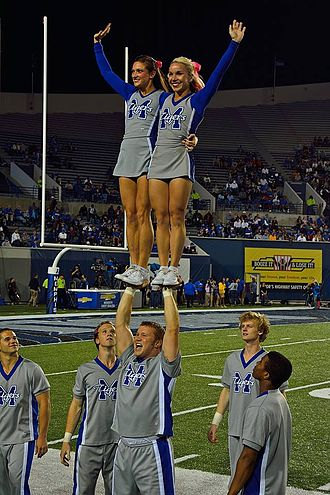
Source: Wikipedia
@Misakii
Cheerleading ranges from a team changing stunts or dancing for another sports team to intense physical activity. Routines are typically 1-3 minutes long, and include tumbling, stunting, jumps, and dance. Cheerleading is closely associated with football, but can be associated with other teams, or with no teams at all. Cheerleading began as an all male activity in the US, and it remains most popular in the US. The sport has become more popular in some countries, such as Australia, Canada, Mexico, China, Columbia, Finland, and more. Cheerleading holds the highest rate of catastrophic injury to female athletes, mostly due to stunting.
Before organized cheerleading, in the late 18th century, male students began to act out in response to harsh treatment by their teachers. Some students began by forming extracurricular activities. This brought about colligate sports. The UK began to yell at sport games to cheer on their teams, which moved over to the US.
Organized cheerleading began as an all male sport. By 1877, Princeton University had a cheer, this was yelled by the students and athletes. In 1898, Johnny Campbell directed a crowd to cheer, becoming the first cheerleader.
In 1923, women were first allowed to join cheerleading in the University of Minnesota, though other schools were slow to follow. Female cheerleader were overlooked until WW2, when males were drafted to war. In 1949, Lawrence Herkimer invented the first cheerleading jump, the herkie. The pom pom was also patented by him.
In the 1950s the NCA (National Cheerleading Association) was founded and female participation began continued to grow, with schools saying males occasionally joined and that cheerleading would remain a feminine activity. Pee Wee and youth leagues began to include cheerleading as well. Professional cheerleading began as well, with women chosen for their dance skills alone, as well as their ability to conform to males attention, as they were the target group.
In the 1960s cheerleaders were employed by the NCA to teach high school students fundamental cheer skills. In 1975, an estimated 95% of cheerleaders were female. Cheer competitions began to pop up in 1967, but it wasn't until 1978 that the first national broadcast of cheerleading competitions began.
In the 1980s, cheerleading began to look more like the cheerleading of today. Difficult stunt sequences and gymnastics were incorporated into the routines. All star teams, which are teams not associated with a different sports team, began to pop up. Cheerleading is overwhelmingly female, with about 97% of modern cheerleaders being female, although in colleges generally 50% of cheerleaders are male. New safety regulations were put into place when a cheerleader fell from a pyramid and suffered a fractured vertebra, bruised lung, and a concussion.
There are many types of cheerleading teams today. They include competitive and non competitive, school and not school teams, dance teams or full on tumbling, stunting, ect teams. For school teams there are elementary through college teams. There are also professional teams and all star teams, who are not affiliated with a school team.
Here's a stunt image just because I think it's impressive:
Source: Wikipedia
@Misakii


![WHOS [RandAlThor]](https://kpopsource.com/data/medal/1148_1589468878m.jpg)


